

What This Conflict Resolution Training Covers
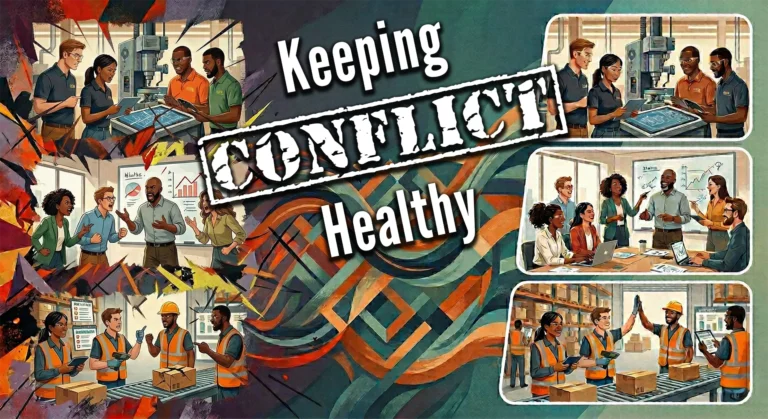
Conflict is not going away. What changes is whether your managers know what to do with it. Keeping Conflict Healthy gives supervisors and team leads a complete operating system for conflict resolution — named frameworks, real scenarios, and a 30-day action plan that turns learning into behavior change.
- Read Conflict Early: Use the Conflict Signal Framework to detect, decode, decide, and deploy — before a situation escalates into something harder to fix.
- Know Your Own Style: Identify your TKI conflict style and understand exactly how it is already shaping your team’s dynamic, whether you realize it or not.
- De-escalate in Real Time: Apply a five-step de-escalation sequence for the in-the-moment tension that shows up without warning, in person and virtually.
- Listen at the Right Level: Use the HEAR Framework to engage with the emotion and the need beneath the surface, not just the content of what someone is saying.
- Have the Hard Conversation: Structure the planned conversation you have been avoiding using the research-backed SBI-I Framework from the Center for Creative Leadership.
- Facilitate Without Taking Sides: Navigate conflict between employees using a four-step facilitation approach that protects your credibility with both parties.
- Intervene at the Team Level: Recognize when conflict has fractured beyond two people and know how to address the system, not just the individuals.
- Make the Escalation Decision: Use a clear decision framework to know when to handle conflict yourself and when to involve HR, every time.
- Build Conflict-Aware Norms: Introduce explicit norms that make healthy tension a standard part of how your team operates, not an exception.
- Leave with a Plan: Complete a written 30-day Conflict Leadership Action Plan with three specific behavioral commitments and a built-in accountability structure.
Who This Conflict Management Training Is For
- Supervisors and Team Leads: Managers who need a repeatable system for the conflict situations they face every week, not just the dramatic ones.
- Shift Leads and Plant Managers: Operations leaders navigating conflict in fast-paced, high-stakes manufacturing environments where tension moves fast.
- Office and Professional Services Managers: Team leads managing peer conflict, cross-functional friction, and the hard conversations that come with client-facing work.
- Remote and Hybrid Leaders: Managers whose teams operate across distance, where conflict signals look different and the usual tools do not always apply.
- New and Experienced Managers: Whether you were promoted last month or have been leading for years, this course gives you frameworks you can name and return to.
Why Most Conflict Management Training Does Not Work
The Core Problem: Awareness Without Application
Most managers were never taught how to handle conflict. They were promoted because they were good at their job, and then handed a team full of people with competing priorities, different working styles, and real friction between them.
So they did what most people do. They avoided it. They smoothed it over. They told themselves it would work itself out.
It did not.
85% of employees experience conflict at work. U.S. employees spend an average of 2.8 hours per week dealing with it, costing organizations an estimated $359 billion in paid hours annually. That is only the conflict being actively addressed. The avoided conflict is harder to measure and arguably more expensive.
Most conflict resolution training compounds the problem by stopping at awareness. It tells managers what conflict is without giving them a repeatable system for what to do about it. Awareness without application is not development. It is a box checked.
The other common failure is treating conflict as a single skill, when it is actually four decisions stacked on top of each other. What type of conflict is this? What is my role in it? What does this situation call for? And when does it need to go to HR? Get any one of those wrong and the intervention fails, which is why so many managers conclude it is easier to just stay out of it.
The Structural Solution: A Named System for Every Situation
Keeping Conflict Healthy was built around a simple premise: managers do not avoid conflict because they do not care. They avoid it because they do not have a system. Give them a system and they use it.
The course starts where most training skips entirely — with the manager’s own conflict style. Research published in the Harvard Business Review found that while 95% of leaders believe they are self-aware, only 10 to 15% actually demonstrate genuine self-awareness when assessed. That gap, between how you think you show up in conflict and how your team actually experiences you, is where most conflict mismanagement lives. Before the course gives you tools for other people’s conflict, it helps you understand your own.
From there the course builds a complete toolkit across six lessons and three phases. Phase 1 covers the foundation: what conflict actually is, the three types you will encounter, and how to read any situation before reacting. Phase 2 covers the skills: de-escalation, active listening, and the hard conversation framework. Phase 3 covers leadership: peer conflict, team-level dynamics, escalation decisions, and building a culture where healthy conflict becomes the norm.
The Outcome: Teams That Surface Problems Early
The goal of this course is not a team without conflict. It is a team where concerns come to the surface while they are still manageable, hard conversations get had before they become crises, and managers feel equipped to respond rather than hoping things resolve on their own.
Organizations with effective conflict management see a 25% improvement in innovation capabilities. The conflict on your team is either costing you or contributing to you. How your managers respond is the difference.
Every lesson includes parallel scenarios for manufacturing and office environments so managers in both contexts see themselves in the material. The course also addresses virtual and hybrid settings throughout, because conflict looks different across distance and the in-person tools do not always transfer. The course closes with a 30-day Conflict Leadership Action Plan built on research from the Center for Creative Leadership, where 70% of real leadership development happens through on-the-job application. The course is your 10%. The plan activates the 70%.
Keeping Conflict Healthy is included in the Arrington Coaching Leadership Pipeline Builder Subscription. No per-course fees. No consulting minimums. Just immediate access to training that gives your managers the skills to lead through conflict with confidence and build teams that are stronger because of it, not in spite of it.
If your managers are avoiding difficult conversations, watching team tension quietly compound, or struggling to build an environment where people speak up, this course is where that changes.
Frequently Asked Questions
What is conflict resolution training for managers?
Conflict resolution training for managers is structured learning that equips supervisors and team leads with the frameworks, language, and practice to read conflict early, respond deliberately, and build teams where healthy tension drives better outcomes. Effective training goes beyond tips and principles to give managers named frameworks they can return to in real situations with real people. Keeping Conflict Healthy covers six lessons including conflict styles, de-escalation, the hard conversation, peer and team conflict, escalation decisions, and building a conflict-aware culture.
How do you de-escalate conflict in the workplace?
De-escalation starts with the manager, not the other person. The five-step sequence covered in this course is: pause before responding, lower your own emotional temperature first, acknowledge without agreeing, slow the conversation down physically, then redirect to the issue. The most important step most managers skip is the second one. You cannot effectively de-escalate someone else while you are still escalated yourself. In virtual settings, the single most effective de-escalation move is to stop typing and get on a video call. Text strips tone and makes conflict escalate faster, not slower.
When should a manager escalate a conflict to HR?
A manager should escalate to HR immediately when the situation involves any allegation of harassment, discrimination, or retaliation; a policy or safety violation; a formal grievance; union or contractual considerations; a power imbalance that prevents fair informal resolution; or any situation where the manager is personally involved or accused. When in doubt, loop HR in early. It is always better to consult and not need it than to need it and not have consulted. The frameworks in Keeping Conflict Healthy are designed for everyday conflict in normal team dynamics and are not a substitute for your organization’s formal HR process.
How do you handle conflict between two employees?
The approach depends on which situation you are in. If both employees report to you, your role is facilitator with authority: hear each side separately, find the shared interest beneath the opposing positions, bring them together with structure, set clear expectations, and follow up. If one employee reports to you and the other reports to a different manager, contact your counterpart manager before taking any action. You cannot resolve cross-team conflict alone without turning a two-person situation into a four-person one. If neither employee reports to you, your role is limited to offering structure and asking good questions. You cannot set expectations or enforce outcomes in that scenario.
What are the five conflict management styles for managers?
The five conflict management styles come from the Thomas-Kilmann Conflict Mode Instrument, one of the most widely used conflict assessment tools in organizational settings. The five styles are: Competing (high assertiveness, low cooperativeness), Collaborating (high assertiveness, high cooperativeness), Compromising (moderate on both), Avoiding (low assertiveness, low cooperativeness), and Accommodating (low assertiveness, high cooperativeness). None of the five styles is universally right or wrong. The goal for managers is style flexibility: the ability to read what a situation requires and choose a deliberate response rather than defaulting to habit under pressure.
Is this conflict resolution training right for both manufacturing and office environments?
Yes. Keeping Conflict Healthy was built specifically for both environments. Every lesson includes parallel scenarios for manufacturing and office or professional services settings so managers in both contexts see themselves in the material. The frameworks are equally applicable on a production floor and in a corporate office. The course also addresses conflict in virtual and hybrid settings throughout, since a growing number of both manufacturing and office managers lead teams across distance where conflict signals look different and the standard in-person tools do not always apply.